Monday, October 4, 2010

Popol Vuh and Ta Chuan

FOREWORD


Ch'ien and K'un are known within I Ching and its appendices as the Gates or poles of Changes; they are represented as the first pair of figures in the Book of Changes wherein they are colloquially called Heaven and Earth, respectively.  They are also called the Two First Powers, and as such can be regarded as primordial YANG and YIN, the products of the division of Taiji. The process of Change and all the "ten thousand things" (a metaphor for all beings and phenomena between Heaven and Earth) is understood as a consequence of the interaction of Heaven and Earth.

Ta Chuan (The Great Treatise) is typically included as an appendix to the text of I Ching, but stand-alone editions may be found.  It is a primer to I Ching, though beginning students will find it somewhat of a fanciful description of Ch'ien, K'un, and the process of Change they engender.  It is this author's personal opinion that editors of I Ching do their works a disservice by not presenting 
Ta Chuan as an indispensable handbook.


These texts are provided to highlight the importance placed by the authors/commentators on "seeing" life clearly or seeing the system of Changes.  The respective writers of Ta Chuan and Popol Vuh heaped praises on the texts, and emphasized the power that can be obtained through study and contemplation of the respective texts.

==
Selected verses from Ta Chuan, The Great Treatise

Ta Chuan
- Section 2
VI - 1
See also: Section 1, Chapter XII-3.
The master said: 'Ch'ien and K'un may be regarded as the gate to the I'.  Ch'ien represents what is of the yang nature (bright and active); K'un what is of the yin nature (shaded and inactive). These two unite according to their qualities, and there comes the embodiment of the result by the strong and weak lines. In this way we have the phenomena of heaven and earth visibly exhibited, and can comprehend the operation of the spiritual intelligence.


Ta Chuan - Section 1
XII - 3
May we not say that Ch'ien and K'un are the secret and substance of the I? Ch'ien and K'un being established, the system of changes was thereby constituted. If Ch'ien and K'un were taken away, there would be no means of seeing that system; and if no changes were seen, Ch'ien and K'un would almost cease to exist.

==

Excerpt from foreword to Popol Vuh (tr. by Allen J. Christenson), in reference to the pre-Columbian version of that book:

This account we shall now write under the law of God [31] and Christianity. [32] We shall bring it forth because there is no longer the means whereby the Popol Vuh may be seen, [33] the means of seeing clearly that had come from across the sea—the account of our obscurity, and the means of seeing life clearly, as it is said. The original book exists that was written anciently, [34] but its witnesses and those who ponder [35] it hide their faces. [36] Great is its performance [37] and its account of the completion and germination [38] of all the sky and earth—its four corners and its four sides. 


All then was measured and staked out into four divisions, doubling over and stretching the measuring cords of the womb of sky and the womb of earth. [39] Thus were established the four corners, the four sides, [40] as it is said, by the Framer and the Shaper, the Mother and the Father [41] of life and all creation, [42] the giver of breath [43] and the giver of heart, [44] they who give birth and give heart to the light everlasting, [45] the child of light born of woman and the son of light born of man, [46] they who are compassionate [47] and wise in all things—all that exists in the sky and on the earth, in the lakes and in the sea.

==

Excerpt from foreword to Popol Vuh (translated by Allen J. Christenson), in reference to the purported divinatory power of the book

By far the most important extant example of such a transcription is the Popol Vuh, a lengthy document composed by anonymous members of the Quiché-Maya aristocracy in Guatemala soon after the fall of their capital city to the Spanish conquerors. The authors of the manuscript described the text as an ilb'al (instrument of sight) by which the reader may “envision” the thoughts and actions of the gods and sacred ancestors from the beginning of time and into the future. The opening chapters of the Popol Vuh. The fact that the contents of the original Popol Vuh predated the Spanish conquest gave them an aura of mystery and power. 


Its authors referred to the ancient book upon which the [24] Popol Vuh was based as an ilb'al, meaning “instrument of sight or vision” (p. 64; lines 51-52). The word is used today to refer to the clear quartz crystals that Quiché priests use in divinatory ceremonies. It may also be used to refer to magnifying glasses or spectacles, by which things may be seen more clearly. 

==


Excerpt from text of Popol Vuh
Thus the rulers (Cucumatz and Co Tuha were enchanted people and enchanted lords. Quicab and Cauizimah were also enchanted lords) of the Quichés consulted the Popol Vuh in times of national distress as a means of seeing the future: They knew if there would be war. It was clear before their faces. They saw if there would be death, if there would be hunger. They surely knew if there would be strife. There was an instrument of sight. There was a book. Popol Vuh was their name for it. (p. 287)


Friday, October 1, 2010

Xiantian: Commutativity, Complementarity, -(Certainty)


The Book of Changes comprises 64 lineal figures, where each of the figures may be represented alternatively as: 
two (2) superposed trigram figures, of which eight (8) exist, known as ba gua.
three (3) superposed di-gram figures of which four (4) exist, called xiang.
six (6) individual yao (lines), of which two (2) exist, open and closed or yin and yang.

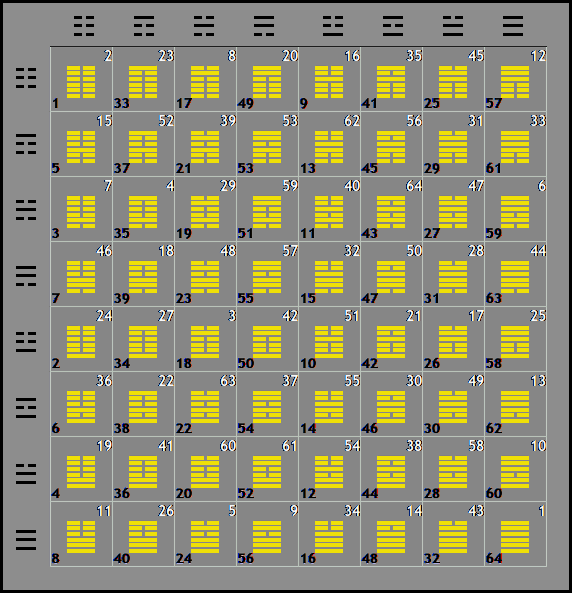
While the ba gua, or eight trigrams have various presentations, a useful presentation is one that interprets them as complementary pairs as when represented in binary notation as given to us by Fu Xi in the so-called familial arrangement:
Add caption
The image below presents the traditional Fu Xi ordering, wherein the 64 figures are arranged on a 8x8 matrix, beginning with upper-left (Earth), permuting in an orderly fashion across the rows and through the series, finishing with lower-right (Heaven).  The numbers in the table cells are indices to the hexagram figures.  The numbers in black are binary values of the corresponding hexagram; the white numbers correspond to the King Wen sequence of hexagrams


Below, we present the FuXi in a mild variation of its traditional form.  We have rotated the picture of the sequence by 45 degrees anti-clockwise so that EARTH is at the top, and HEAVEN is its antipodal pair at the bottom. This positioning reveals a vertical axis passing through this pair of figures that is comprised of the "doubled" hexagrams.  Such hexagrams are named for the two identical trigrams  comprising the hexagram figure; these same trigrams are in the table above.  We term this the South-North axis.


The eight doubled hexagrams along this axis in order from top to bottom are:
2) EARTH, 52) MOUNTAIN, 29) WATER, 57) WIND, 51) THUNDER, 30) FIRE, 58) LAKE, 1) HEAVEN.


The horizontal axis oriented at 90 degrees to the South-North axis we will term the West-East axis.  Unlike the other axis, it is composed of hexagrams that are composed of two anti-symmetric trigrams.  In order from left to right these are:
11) PEACE, 18) DISRUPTION, 63) AFTER COMPLETION, 42) INCREASE, 32) PERSEVERANCE, 64) BEFORE COMPLETION, 31) SENSITIVITY, 12) OBSTRUCTION


superposed trigrams a before-after depiction, with CHANGE occurring between


superposed trigrams an external context, and an internal text, the former being a projection of the latter?]


 If a pair of trigrams depicts a situation both before and after a Change, we can characterize any single Change as a system composed of operator(s) and operand(s).  One such characterization posits that the operator is the arrangement, in superposition or juxtaposition, of the component trigrams so that the bottom, middle, and top lines of the two trigrams correspond. The operands are the trigrams themselves.

It should be noted that the primary axis comprises a set of Changes such that for each Change, the anterior or original condition is identical to the posterior or resultant condition.  In other words, the eight hexagrams along the primary axis are all internally commutative.  That is, if we were to reverse the order of the operands, the result is the same hexagram as if we had not.
Heisenberg showed that the commutation relation implies an uncertainty, or in Bohr's language a complementarity. Any two variables that do not commute cannot be measured simultaneously—the more precisely one is known, the less precisely the other can be known. (from http://en.wikipedia.org/wiki/Uncertainty_principle)
These complementary operands do commute; in the language of quantum mechanics this implies that the uncertainty condition described above does not apply to the hexagrams on the primary axis.  One might infer from this feature that the eight hexagrams on the primary axis somehow stand apart, are isolated, or insulated from Change.  They present a ground against which the others form figures.


[speculative] 
This analogy hints at the nature of a subspace, upon which stand the Ba Gua hexagrams as skeletal supports of 3-D space, around which akasha is wrapped.  The resulting figure is analogous to a cube, hence the use of the "hypercube," as a model for Being.


Alternatively, it suggests that the Ba Gua hexagrams, insofar as they serve as the "skeleton" or framework for akasha, are in a permanent state of superposition.  It follows from the latter that the Ba Gua are eternally non-manifest and unconditioned, since any observation or measurement of them would tend to collapse the superposition, thus, collapsing the 3-D space engendered. 
[close]

When we inspect the secondary axis, however, we observe a different situation.  In fact, none of the remaining fifty-six hexagrams commute internally; reversing the positions of the trigrams for these hexagrams produces a different hexagram in each case.  This non-commutativity relation tells us that the internal condition of these hexagrams is not complementary. In the language of quantum mechanics, the constituent trigrams may be said to represent incompatible observables, meaning that the two trigram components of the Change under investigation cannot be simultaneously evaluated with arbitrary precision.
[Incompatible observables are conveniently interpreted as wholly disparate "views" of the same underlying reality, as in the case of waveform--corpuscular manifestations of electrons]  

These fifty-six Changes may also be understood as forming twenty-eight pairs, each half being the complement of its mate.  Being complementary, each of these twenty-eight pairs of Changes enjoy a commutative relation.  Such a relation, as we have suggested, does not invoke the quantum mechanical uncertainty condition. Fourteen of these pairs are assumed to represent conditions in the Celestial realm, with the Mundane realm accounting for the remaining twenty-eight Changes.

[speculative]
In the case of an entangled pair of subatomic objects, state-change of one entails instantaneously equal and opposite state-change in its twin, regardless of their respective locations. This condition implies a dimension of identity shared across the entangled pair.   The quantum states of the entangled objects are said to "instantaneously commute"  or "teleport" across the pair.  Through the [suspected] underlying identity, no signal is passed "between" the pair, thus the luminal barrier is not violated.


In the language of quantum mechanics, this complementarity across pairs suggests that one may know with precision the states of either member of the pair, though one may not know the internal quantum states of either member.  This implies that uncertainty may not apply to the entangled pair--this is the same situation we suggested might obtain from the Ba Gua hexagrams along the primary axis.
[close]


Remaining to be determined:
Given that the function of the oracle is to quantize or measure the uncertainty surrounding the diviner's inquiry: 

  • What does uncertainty mean within the context of divination or Change?  
  • What does the notion of "incompatible observables" mean in the context of Change?


Friday, September 17, 2010

Wheel Cross: Navigation Tool of Antiquity


Its overall appearance is reminiscent of the comic book character "X-Men" insignia (a cross within a circle); less recently, of a religious symbol.  Wikipedia's article on religious symbols provided the first pointer (below right) but symbols.com provided clear confirmation of this symbol's place within our overall field of investigation:
The wheel cross, sun cross, Odin's cross or Woden's cross. Nordic Odin and Teutonic Wotan or Woden was the supreme god of the Nordic religion before Christianity. Odin was the god of art, culture, warfare, and the dead; depicted as an old, one-eyed man with two ravens as his intelligence agents and messengers.  
Sun Cross 
 The structure 2901 is one of the first non-pictorial graphs to appear when humankind was on the threshold of the Bronze Age. It is common on rock carvings. It appears in ancient Egypt, China, pre-Columbian America, and the Near East. From the facts available it seems as if 2901 is associated with the wheel, not so much with its invention as with its revolutionary effect on the existing society. In ancient China this sign was associated with thunder, power, energy, head, and respect. 
This figure is also known as the gamma cross, as the Greek letter 'gamma' appears four times within the circle, radially rotated.  It is shown to play a prominent role in the Norse, Egyptian, Chinese, and pre-Columbian culture.  Perhaps excepting the Egyptian, this observation is consistent with our thesis that the religion of these cultures is based on representations the Tree of Life

The sun cross embodies several notable features: the circle, the right angle, the line segment, and the point.  These figures are all associated with measurement, surveying, mathematics, Platonic geometry, and Freemasonry.  Another feature is the fact that the sun cross can be reassembled into the Ankh cross, by remaking the Greek cross into a Tau cross, and placing the circle atop.

Crichton Miller's research on the Celtic cross convincingly demonstrates its use in antiquity as an instrument of spherical/nautical navigation based on the impeccably-supported theory that working models of the true Celtic cross embody a weighted rotating wheel.  as the circular portion. Moreover, the Celtic cross was used as a tool of determining longitude and latitude.  That Wotan's wheel cross and the Celtic cross bear both a figurative and literal resemblance is worthy of remark.


Thursday, September 16, 2010

Eight Partition Place - Sun Cross

hand-wrought copper wire


At left is the most-recent in a series of wire-frame models depiciting the 8-Partition Place.  The outermost circumference approximates that of a penny.  Eight Partition place was purportedly known to the Mayan priesthood (need cross-reference).  


Copper John peddles his wares outside 5 Spot (summer '10)
This one took several hours to complete.  It began as a scrap length of copper wire that spoke to me as it lay on the ground.  I pocketed it, giving it scarcely a thought for over a week's time.  Its gauge seemed somewhat heavy to be easily hand-worked at that length.  Memories of the initial effort with wire-hanger are not yet faint enough.


Luckily for me, "Copper John" of L5P had given me excellent instruction on working this handsome and easily-fashioned metal.  He told me he has material on YouTube; look for him.


Tuesday, August 31, 2010

Octopartition pt. I

The figure on the right is a representation of the Mayan One God Hunab-Ku.  According to Dr. C.J. Calleman, author of Purposeful Universe, other names given to this supreme entity of the Maya include Eight-Partition Place, the One Giver of Movement and Measure, and the One Giver of Energy and Boundary.  This notion of eight partitions or octopartition would present itself again.  It should be mentioned that Hunab-Ku is not regarded as an individual being, but as all BEING, the fundament of all existence.


Similarity between this hand-fashioned wireframe model at left and the 2x2x2 binary hypercube suggests itself.  Likewise, there is similarity between the process of fashioning the wireframe model and Taoist cosmogony:


  • Measuring, closing a strand of wire (differentiation, singularity)
  • Twisting (Great Axis) a loop yields two loops (Two First Powers)
  • Two loops intermingle to produce quadrants (Four Symbols)
  • Twisting a orthogonal third axis results in octopartition (Eight Diagrams or Ba Gua)


Binary hypercube
Three loops, three axes, three operations are needed to create space from a singularity.  It should be mentioned that the Taoist conception of nature is represented by Man, positioned or crucified "at the crossing" of Heaven and Earth.  These three are explicitly termed the Three Operations in The Great Treatise; we now have some idea of the reason for this terminology.


Octopartitioning is arguably special because it encompasses all spatial directions -- up, down, and all the cardinal points.  If one considers the Origin (the point at the center of the cube, within is also represented.


from "Purposeful Universe"
Astrophysicists have reportedly determined that the Milky Way galaxy is similarly octopartitioned by the orbit of the Earth as it travels about the galactic center.  


Thus, a galaxy, our Earth, or any physical object may be visualized or modeled by means of the octopartition.  Indeed, navigation makes extensive use of this feature.


Hand-wrought copper wire
In theory, the number of partitions could have continued to double indefinitely; this is one reason why they do not: with only Three Operations on a simple closed loop, we have the basis of matter and phenomena to be allotted discrete locations in space and enter Being from non-existence.  No additional dimensions are necessary to support the emergence of Humanity with its power of Consciousness coupled with its ability to undergo Experience.


Thus, an octopartition represents akasha, or space, but what about time?  Time implies Change, else it is pointless to measure time.  
In order to represent the fourth dimension, we must account for Change, but how?  
The answer: repetition.  That is, to arrange two similar objects to represent the first object both before and after a change as depicted in the graphic at right.