Showing posts with label superposition. Show all posts

Thursday, October 27, 2011

Treatment of Hexagrams as Trigram Superpositions

Legge, 1879
Trigrams are composed of three "places" or "positions", each "containing" YIN (0) or YANG (1).  The trigrams will be denoted by triplets read left to right as in the diagram below.  In the wireframe diagram (below right), the numbered vertices stand for the trigrams.


Hexagrams are composed of a trigram pair arranged in superposition: lower and upper, or inner and outer. The places are numbered 1 through 6 from bottom to top.  Therefore, we can depict an hexagram using our unit square wireframe diagram by connecting any two vertices with directed paths.  The syntax for this poses the original vertex as lower trigram, the terminal vertex as upper.
For example, the directed path leading from (1,1,0) to (0,0,1) gives ䷨ hexagram #41, Reduction. Reversing the direction of the path produces ䷩ hexagram #42, Increase.
Each of the eight vertices has seven outbound paths to each of the other vertices, totaling 56 paths.  Half of these paths are duplicates, in the sense that the paths connect the same pair of trigrams; thus, the 56 paths comprise 28 pairs of heterogenous* hexagrams.  Each vertex can also loop back to itself.  These 8 loops constitute 4 pairs of homogenous* hexagrams.  An outbound path and its reversal constitute a Wen Pair; loops at antipodal corners (e.g. the example given above) also designate Wen pairs.
*The terms heterogenous and homogenous (applied to hexagrams) refer to the constituent trigrams

Given the yao-numbers derived from Wen's hexagram pairs, we are enabled to assign a weighting to each path, and treat the paths as proper vectors.

Tuesday, October 12, 2010

Quantifying Change: Uniting the Oracle with the Changes

Quantifying Change: Uniting the Oracle with the Changes

One troublesome aspect of I Ching for the author had been that there appeared to be no connection between the yarrow-stalk oracle (ostensibly presented by Confucius) and the text. To the point, the text of I Ching does not speak in terms of the four xiang, only in terms of greater YIN [6] or greater YANG [9].  Lesser YIN [8] and lesser YANG [7] are not referenced in the text.  

The divination ritual provided by Ta Chuan introduces the four digram figures denoting HEAVEN or greater YANG [⚌], FIRE or lesser YIN [⚍], WATER or lesser YANG [⚎], and EARTH or greater YIN [⚏] by the numbers [9,8,7,6] respectively.  The xiang, as the digrams are called, have a long heritage within I Ching tradition. The xiang constitute all permutations of the two basic lines [⚊], [⚋] taken in pairs (2 x 2 = 4).  Nine and six indicate changing conditions in a divination, but the reader of I Ching cannot possibly observe changing conditions in a hexagram figure that displays them statically.

Put differently, examining the 64 hexagram figures outside the context of divination provides little means to discern whether a given hexagram has moving lines, or the positions at which they occur – changing lines are essentially meaningless outside the divination context.  Without knowledge of where and how Change occurs, one attempting to systematize or quantify the Change would be left to broadly assign 9 (or 7) in place of YANG, and 6 (or 8) in place of YIN wherever YIN and YANG lines are encountered.

An initial step taken towards quantifying and measuring Change involved adopting a shift in perspective from which it follows that Ch'ien ("all nines") and K'un ("all sixes") refer to situations with all 6 positions are changing in parallel.  As situations, all hexagrams are thus dynamic contexts, not merely still images as they are appear in the text.  

In Taoist cosmogony, xiang are regarded as the primordial reality that emerged after YIN [⚋] and YANG [⚊] separate and emerge from the Taiji singularity, which differentiated itself from the Way (Tao) in order that Reality might be made manifest.  Thus, in the context of I Ching, Changes may also be understood as comprising three digrams which represent the Three Powers: EARTH, HUMANITY, and HEAVEN.  The relevance of this will shortly be made apparent.

Initially, the expanded first-order difference integers accounted only two types of line-changes: YIN changing to YANG, and conversely, at any of the six positions.  In the following depiction of Change #5, the white-spaces in the 2nd and 5th places betray flaws in the original version of the expansion procedure:

Such white-spaces invariably arose from the two non-change conditions: unchanging (or static) YANG, and unchanging (or static) YIN.  It became clear that for any Wen pair and at any of the six positions, four kinds of line-changes may manifest.  To omit or treat identically the two static conditions when they clearly denote different states is to commit the same errors McKenna committed with Timewave by only considering the number of line-changes while ignoring the places at which they occur and by ignoring non-changing positions.  

On learning of the xiang and their suitability for representing the different kinds of line-changes, the author refined the expanded first-order difference operation (renamed as Change) by using xiang bi-grams to denote the four discrete types of line-changes.  This Change procedure was iterated over the full set of 32 Wen pairs, producing thirty-two Changes.  However, yao-number 144 does not occur in these thirty-two Changes produced per the rules given in Ta Chuan.  Furthermore, the yao-numbers corresponding to these thirty-two Changes did not sum to 11,520.

It was determined that the only way to produce the yao-number 144 thus effecting "all sixes” changing at once is for K'un to transform into Ch'ien.  This occurs when one reverses the ordering of King Wen pair #1 to indicate #2 Earth changing to #1 Heaven.  This implies that the remaining Changes are produced by reverse passage through the King Wen sequence.

Initially, King Wen pairs were deemed properly-formed when an oddly-indexed hexagram is followed by an evenly-indexed hexagram; e.g., [1,2] or [29,30].  Subsequently, the rule for a properly-formed King Wen pair was expanded to include the reverses of the Wen pairs, and the procedure was amended to iterate over the additional thirty-two Wen anti-pairs (reversed Wen pairs) which completed the Canon of sixty-four Changes.  The yao-numbers (11,520) were then found to sum correctly, and  the yao-numbers corresponding to hexagrams #1 and #2 properly sum to 360.   


NB: While the yao-numbers of Wen pair [1,2] indeed sum to 360 (also true for anti-pair [2,1]) , we discovered that pairs do not always sum to 360.  The smallest yao-number sum of a King Wen pair was observed to be 344: [9,10], [13,14], [43,44]; the largest yao-number sum observed was 376: [7,8],[15,16], [23,24].


We now have a probability distribution for the King Wen Sequence.  The yao-numbers and their relative frequencies are:  144 (1), 168 (3), 172 (6), 180 (20), 184 (12), 188 (6), 192 (3), 216 (1).   A graphical representation of the “King Wen Distribution” (including distribution statistics) follows.
King Wen's Distribution

Quantifying Change: Number Magic

Quantifying Change: Number Magic
The Master said: "He who knows the method of change and transformation may be said to know what is done by that spiritual power."
This post specifically treats a section of Ta Chuan (the Great Treatise) chapters 52 through 58. This text may be found in James Legge's translation of I Ching, and in Stephen Karcher's (2000) translation of Ta Chuan, where the corresponding chapter is entitled "Number Magic and Consultation." The goal of this work is to solidify the means of quantifying and measuring change. Central to this approach is adopting a new look at the 64 familiar hexagram figures.

"Number Magic" begins by designating even numbers as YIN and odd numbers as YANG. To this point, the He Tu diagram depicts the counting numbers one through ten with light-colored (YANG) and dark-colored (YIN) dots.


The He Tu (diagram) is traditionally said to originate from the emergence of a dragon-headed horse with carp-like scales that emerged from the Yellow River. Its body was covered in strange markings which were noted by the sages of the time and studied in depth. Eventually, these markings were codified into a set of dots (see the diagram at right), called the He Tu, or River Map. Many observations about nature were derived from study of the He Tu, including the existence of the north-south axis of the Earth, and the idea that heat rises while cold descends. Gradually, associations with directional and Five Phase energies were incorporated into the He Tu.


NB: Note the enumeration of the four ritual numbers [6,7,8,9] on the periphery of the He Tu diagram.
(Excerpt attributed to http://www.maelearning.com/onlinecourses/store/details.asp?id=4, graphic courtesy of http://www.8whitestarfengshui.com/The_Luo_Shu_and_He_Tu.html; referenced June 2010)


After a description of the yarrow-stalk oracle, also called "the operation by threes and fives" we are given:
The numbers (required) for Ch'ien (or the undivided line) amount to 216; those for K'un (or the divided line), to 144. Together they are 360, corresponding to the days of the year.The number produced by the lines in the two parts (of the Yî) amount to 11,520, corresponding to the number of all things. Therefore by means of the four operations is the Yî completed.
Legge's commentary on this passage:
"The actual number of the undivided and divided lines in the hexagrams is the same [192 of each]. But the representative number of an undivided line is 9, and of a divided line 6. Now 9 x 4 (the number of the emblematic figures) x 6 (the lines of each hexagram) = 216; and 6 x 4 x 6 = 144. The sum of these products is 360, which was assumed, for the purpose of working the intercalation, as the standard length of the year. But this was derived from observation, and other considerations;--it did not come out of the Yî."

Explication:

Ch'ien appears in a divination when one casts nines (greater YANG) in all six places
K'un appears in a divination, when one casts sixes (greater YIN) in all six places

We propose the following derivation for the numbers
216 = 9 (symbolic for greater YANG) * 4 (xiang) * 6 (positions)
144 = 6 (symbolic for greater YIN) * 4 (xiang) * 6 (positions)
216 + 144 = 360 (days in a sacred year)

The number produced by the lines in the two parts (of the Yî) amount to 11,520, corresponding to the number of all things.

In the quoted passage above, “The number of all things,” 11,520, approximates the "ten thousand things," a common reference in the Tao Te Ching. The ten thousand things indicate the products of the interaction of Heaven and Earth, namely, all beings and phenomena between Heaven and Earth. The author admits to some uncertainty on this point, however, because no known references include Heaven and Earth among the ten thousand things. The term applies only to those things that are produced by the interaction of Heaven and Earth. The number of all things, 11,520, is shown by Legge to comprise the yao-numbers of Heaven and Earth, including the ten thousand things, the latter symbolized by the other sixty-two hexagrams.


Legge's notes:

The number in paragraph 53 (11,520) arises thus: 192 (the number of each series of lines in the sixty-four hexagrams) x 36 (obtained as above) = 6912, and 192 x 24 = 4608, the sum of which = 11,520. This is said to be 'the number of all things,' the meaning of which I do not know. The 'four operations' are those described in paragraph 31.
Explication:

I Ching is composed of 384 (6 x 64) lines, half of which are YANG, half are YIN.  This means that 11,520 is the sum of:
6912 = 192 (YANG lines) x 4 (xiang) x 9 (symbolic for greater YANG)
4608 = 192 (YIN lines) x 4 (xiang) x 6 (symbolic for greater YIN)

We should note, however, the subtle clue to a construct inside the Changes: the yao-numbers of hexagrams #1 and #2 are 216 and 144, and the sum of the yao-numbers of all the hexagrams is 11,520 (derived above).  


If Heaven and Earth have yao-numbers resulting from divination ("operation by threes and fives"), we may confidently infer that each of the hexagrams has its own yao-number.  Our goal then, is to find an heuristic to produce an hexagram to yao-number assignment in accordance with the clues given in the text.

We find from the following exercises below that not just any substitution will work, summing yao-numbers over the entirety of I Ching must equal 11,520, and hexagrams #1 and #2 must have yao-numbers 216 and 144 respectively.  We observe that the mean value of any given yao is 7.5 (the average of [6,7,8,9]).  Therefore the lower limit of distributional variance would result from assigning 7.5 to all lines.  Thus, the sum of YANG yao-numbers would equal the sum of YIN yao-numbers.  

The median case of distributional variance results from example A in the table below.  The upper limit of distributional variance of results from example B following.

A: Substituting 7s for YANG and 8s for YIN:
All lines in the CHANGES: 6 x 64 = 384
Lines allotted to YANG and YIN: 192 + 192 = 384
4 * 7 * 192 = 5376 (7 representing YANG lines)
4 * 8 * 192 = 6144 (8 representing YIN lines)
5376 + 6144 = 11520 (
BSubstituting 9s for YANG and 6s for YIN:
All lines in the CHANGES: 6 x 64 = 384
Lines allotted to YANG and YIN: 192 + 192 = 384
4 * 9 * 192 = 6912 (9 representing YANG lines)
4 * 6 * 192 = 4608 (6 representing YIN lines)
6912 + 4608 = 11520 (Legge's solution)


Note that the Changes corresponding to hexagrams #1 and #2 would not have the correct stick-numbers under scheme A, though the sum of the numbers yielded is 360.  These explorations demonstrate that the means of representing YIN and YANG over the sixty-four Changes has consequences for the balance of YIN and YANG.  


From these results we confirm that the heuristic we sought for generating a yao-sum from a Change is equivalent to multiplying by four the appropriate ritual number at each of the six positions.

Returning to our example of Change #28 which emerges from hexagram #55 and hexagram #56, we enumerate the ritual numbers of each position, to yield [987786].  Multiplying each of these six ritual values by four produces [45 * 4 =] 180, which is the yao-sum for Change #28 (which we derived from the Change operation).

Conclusion: While Legge's method is mathematically correct, it alters the distribution of Change by limiting its consideration of ritual numbers to greater YIN [6] and greater YANG [9], while ignoring lesser YIN [8] and lesser YANG [7].

Quantifying Change: Defining the Chan...

Quantifying Change: Defining the Change operation

Considering any King Wen pair of hexagrams, making comparisons across the members of the pair at each of the six positions, observing and denoting where line-changes occur, the type of line-changes, and where line-changes do not occur, describes the Change operation.  The product of this operation constitutes an individual Change.  Fully-iterated* over the King Wen sequence, the Change operation produces sixty-four discrete Changes.  These sixty-four Changes bear a close semantic relationship to the sixty-four hexagrams.

NB: *Full-iteration means to apply the Change operation as one traverses the pairs of the King Wen sequence from beginning to end and back to the beginning.

Example: Change #28 is composed of the pair [55,56].  Change #28 describes a situation where two positions, the bottom and top, are changing in different directions:


Position 6 shows YANG changing to YIN
Positions 5 and 2 show static YIN
Positions 4 and 3 show static YANG
Position 1 shows YANG alternating to YIN.

By contrast, its anti-pair, Change #37 (composed of the hexagram pair [56,55] also has two changing lines and four stable lines, but the polarity of each changing line is the opposite of Change #28.  Static lines, by nature, do not change polarity.


Position 6 shows YIN changing to YANG
Positions 5 and 2 show static YIN
Positions 4 and 3 show static YANG
Position 1 shows YIN alternating to YANG.

While a Change has the same shape as a hexagram, it must be emphasized that each Change captures two qualities at each of the six
positions which describe what transpired within the pair resulting from the Change:
  • polarity of the position (in terms of YIN versus YANG)
  • state of that position's polarity (in terms of static versus dynamic).


Polarity and state are terms used to describe qualities that describe mutually-exclusive conditions of a line.  Representing them simultaneously requires (2 x 2 = 4) four values.  Fortunately, we are not required decide how to represent these conditions.  The appendices of I Ching include a section entitled Ta Chuan, the Great Treatise.  Ta Chuan is an invaluable resource for accessing the philosophical and cosmogonical context of the Changes.  Ta Chuan provides a description of the “method of threes and fives” (i.e., the yarrow stalk oracle), a divination ritual commonly used at the time of its writing.  The description of the yarrow-stalk oracle includes a discussion of the ritual numbers [6,7,8,9].  These ritual numbers will serve to track polarity and state as described above.

The first thirty-two King Wen pairs (H,H') are as follows: [1,2], [3,4], ... [63,64]. The remaining thirty-two King Wen pairs are the reversals, pair-wise and sequential, of the first thirty-two pairs: [64,63] [62,61], ... [2,1]. Performing the Change operation (taking the expanded first-order difference within the sixty-four King Wen pairs), produces a sequence of sixty-four figures which record the positional state-changes that occurred within each pair as the Wen sequence is traversed to its end and back.  The pair-wise Change operation is continuous over the sequence of sixty-four hexagrams.  

The ritual numbers six, seven, eight, and nine are central to the divination ritual and are described as xiang, or symbols, which we employ for representing the four kinds of Change.   The cosmogonical origin of the four xiang appears to stem from the initial intermingling of the primordial YIN and YANG (the Gates of Change, Ch'ien and K'un, represented by Changes #1 and #2).  Indeed, this can shown geometrically:

The Cartesian plane is composed of two axes which we may use these represent Ch'ien and K'un. We may use resulting quadrants to stand for the xiang:

⚏  [6] = greater/dynamic YIN (alternates to YANG)
⚎  [7] = lesser/static YANG
⚍  [8] = lesser/static YIN
⚌  [9] = greater/dynamic YANG (alternates to YIN)


The positional changes in polarity (YIN or YANG) may be combined to produce a notion of the quantity of Change thus represented.  Such a quantity may take on, for example, the values [2,4,6].  These values reflect the total number of positions undergoing change within a given pair of hexagrams when ordered in the King Wen sequence.  There are other ways of interpreting the quantity of Change as well. For instance, one might count greater YIN and greater YANG individually, which would allow for values [1,2,3].

We also are able to infer some notion of
direction as it regards traversal through the King Wen sequence.  Forward motion through the King Wen sequence is represented by King Wen pairs #1 to #32, return motion is represented by King Wen pairs #33 to #64, which reverse the order of the pairs. Because the Change operation preserves the direction of traversal through the King Wen sequence, the Change operation appears to violate commutativity, though superficially.  

The following table presents the sixty-four King Wen pairs and anti-pairs in a color-coded tabular format.  Change indices, hexagram indices and yao-sums are in the various columns. The thirty-two King Wen pairs are read from upper left to lower right.  The thirty-two anti-pairs are read from lower-right to upper left.

Quantifying Change: Introduction

Quantifying Change: Introduction

In this series of posts, the author purposes to develop a mathematical framework for studying Change, the constant, unvarying.  This paper assumes a practical familiarity with I Ching and its internal structures.
In presenting this treatment of Quantifying Change, the author has spared little effort in making it accessible to the casual student of I Ching, or even to the interested layperson by reducing unnecessary jargon.  Regretfully, everyday language often falls short of providing what is required for this endeavor.  This is especially true where mathematics are concerned.  Clear expression of even straightforward math concepts requires verbal precision that everyday language seldom provides.  The author, where specialized terms have been employed, has attempted to make the meanings clear and relevant to the application of the terms.

Graphic descriptions (far more useful in this regard) have been employed where words proved inadequate.  Future treatments of this topic will make broader use of graphical explanations.


The philosophy espoused by commentators is that study of the Changes can produce a penetrating understanding of the processes of Change as they manifest in our personal lives, in the cosmos, and at the various scales of dimension.  It is reputed that mastery of this discipline enables passage through the world essentially without misstep since one will have developed the ability to reliably discern the appropriate course of action in any situation.

'Change' is capitalized, above and elsewhere, to distinguish common usage from our use in the sense of the philosophy of I Ching.  Generally speaking, reference to 'Change' indicates the eternal process of transformation, creation and destruction, formation and disintegration.  

Herein, reference to 'Changes' or the 'Change operation' will also indicate what were previously called “expanded first-order difference integers*.”  The Changes are a product of the King Wen sequence of hexagrams.  The King Wen sequence is the likeliest form in which one will encounter the Changes. The King Wen sequence is arranged in pairs of hexagrams, beginning with Ch’ien and K’un, the  Gates of Change, represented by hexagrams #1 Heaven and #2 Earth.  It ends with hexagrams #63 After Completion and #64 Before Completion.

NB: *First-order differences is a term coined by the late Terrence McKenna in his presentation of Timewave (elsewhere discussed).  Our treatment of the Changes is a fuller development of McKenna's nascent concept.

It is unclear (and dubious) that any comprehensive explanation of the ordering principle behind the Wen sequence has been published.  This is to say that the sequence has not, to the knowledge of the author, been proven computable or 'deterministic' in the sense that the sequence may be generated from a reasonably small set of inputs and rules.  Compare this to say, the first 64 digits of π, or the of any common mathematical function or value.


<Terminology>
Before Change and the nature of the King Wen pairs are discussed, some terms:
  • xiang: literal meaning: symbol; in this context, indicates the primordial reality (represented by HEAVEN, EARTH, FIRE, and WATER) that is believed to have emerged after the “separation” of YIN and YANG
  • line:  (also: , place, position, or yao) any of the six steps or stages of a situation or process as given by I Ching, ordered from bottom to top.  Lines take on two basic forms: YIN (open, divided), and YANG (closed, undivided).  Through Change, a line may move to a different position within a hexagram, or transform into its opposite; that is, YIN may alternate to YANG, and conversely.
  • ritual number: (closely-related to xiang) a product of the yarrow-stalk oracle which determines the specific type of each line in a hexagram. Ritual numbers may have the following values: [6, 7, 8, 9].
  • digram (also bi-gram): (related to xiang) any of four combinations of two lines (places, positions, or yao) taken as a group.  Digrams are figurative representations of xiang, and have traditional ritual number assignments.
  • trigram: eight discrete trigrams exist; each is a ordered collection of three contiguous lines that compose half of a hexagram.  Two trigrams are traditionally oriented in superposition.  They are named HEAVEN, EARTH, THUNDER, WIND, WATER, FIRE, MOUNTAIN, LAKE.
  • hexagram: any of sixty-four distinct figures composed of six places, lines, positions, or yao. Hexagrams may also be interpreted as comprising three digrams or two trigrams.
  • trigram exchange: an operation where the inner/lower trigram exchanges positioning with the outer/upper trigram such that the inner state becomes the outer state, and conversely.
  • pantonggua: place-wise or positional negation (to/from YIN from/to YANG), applied to an entire hexagram.  YIN lines will alternate to YANG, and conversely.
  • fangua: figure-wise inversion of a six-place hexagram that re-orders it from topmost place to lowest); applied to an entire hexagram.  Line 6 changes places with  position 1, line 5 changes places with line 2, line 4 changes places with line 3, and so on.
  • King Wen pairs: (also: anti-pairs) sixty-four of these exist.  They individually comprise a unique hexagram (H) and its mate (H’).  In general, the mate (H’) is defined by trigram exchange.  Exception: in eight cases this operation produces the self-same hexagram; for those eight cases, the mate is defined as the pantonggua (the positional negation).
  • Changes: (similar to hexagram) An ordered sequence of sixty-four six-line figures reflecting the state-change occurring within King Wen pairs as the sequence is fully-traversed (from beginning to end and back).

Friday, October 1, 2010

Xiantian: Commutativity, Complementarity, -(Certainty)


The Book of Changes comprises 64 lineal figures, where each of the figures may be represented alternatively as: 
two (2) superposed trigram figures, of which eight (8) exist, known as ba gua.
three (3) superposed di-gram figures of which four (4) exist, called xiang.
six (6) individual yao (lines), of which two (2) exist, open and closed or yin and yang.

While the ba gua, or eight trigrams have various presentations, a useful presentation is one that interprets them as complementary pairs as when represented in binary notation as given to us by Fu Xi in the so-called familial arrangement:
Add caption
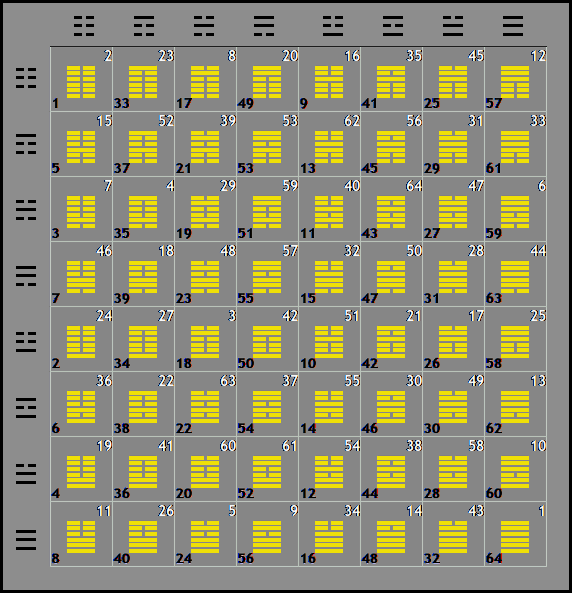
The image below presents the traditional Fu Xi ordering, wherein the 64 figures are arranged on a 8x8 matrix, beginning with upper-left (Earth), permuting in an orderly fashion across the rows and through the series, finishing with lower-right (Heaven).  The numbers in the table cells are indices to the hexagram figures.  The numbers in black are binary values of the corresponding hexagram; the white numbers correspond to the King Wen sequence of hexagrams


Below, we present the FuXi in a mild variation of its traditional form.  We have rotated the picture of the sequence by 45 degrees anti-clockwise so that EARTH is at the top, and HEAVEN is its antipodal pair at the bottom. This positioning reveals a vertical axis passing through this pair of figures that is comprised of the "doubled" hexagrams.  Such hexagrams are named for the two identical trigrams  comprising the hexagram figure; these same trigrams are in the table above.  We term this the South-North axis.


The eight doubled hexagrams along this axis in order from top to bottom are:
2) EARTH, 52) MOUNTAIN, 29) WATER, 57) WIND, 51) THUNDER, 30) FIRE, 58) LAKE, 1) HEAVEN.


The horizontal axis oriented at 90 degrees to the South-North axis we will term the West-East axis.  Unlike the other axis, it is composed of hexagrams that are composed of two anti-symmetric trigrams.  In order from left to right these are:
11) PEACE, 18) DISRUPTION, 63) AFTER COMPLETION, 42) INCREASE, 32) PERSEVERANCE, 64) BEFORE COMPLETION, 31) SENSITIVITY, 12) OBSTRUCTION


superposed trigrams a before-after depiction, with CHANGE occurring between


superposed trigrams an external context, and an internal text, the former being a projection of the latter?]


 If a pair of trigrams depicts a situation both before and after a Change, we can characterize any single Change as a system composed of operator(s) and operand(s).  One such characterization posits that the operator is the arrangement, in superposition or juxtaposition, of the component trigrams so that the bottom, middle, and top lines of the two trigrams correspond. The operands are the trigrams themselves.

It should be noted that the primary axis comprises a set of Changes such that for each Change, the anterior or original condition is identical to the posterior or resultant condition.  In other words, the eight hexagrams along the primary axis are all internally commutative.  That is, if we were to reverse the order of the operands, the result is the same hexagram as if we had not.
Heisenberg showed that the commutation relation implies an uncertainty, or in Bohr's language a complementarity. Any two variables that do not commute cannot be measured simultaneously—the more precisely one is known, the less precisely the other can be known. (from http://en.wikipedia.org/wiki/Uncertainty_principle)
These complementary operands do commute; in the language of quantum mechanics this implies that the uncertainty condition described above does not apply to the hexagrams on the primary axis.  One might infer from this feature that the eight hexagrams on the primary axis somehow stand apart, are isolated, or insulated from Change.  They present a ground against which the others form figures.


[speculative] 
This analogy hints at the nature of a subspace, upon which stand the Ba Gua hexagrams as skeletal supports of 3-D space, around which akasha is wrapped.  The resulting figure is analogous to a cube, hence the use of the "hypercube," as a model for Being.


Alternatively, it suggests that the Ba Gua hexagrams, insofar as they serve as the "skeleton" or framework for akasha, are in a permanent state of superposition.  It follows from the latter that the Ba Gua are eternally non-manifest and unconditioned, since any observation or measurement of them would tend to collapse the superposition, thus, collapsing the 3-D space engendered. 
[close]

When we inspect the secondary axis, however, we observe a different situation.  In fact, none of the remaining fifty-six hexagrams commute internally; reversing the positions of the trigrams for these hexagrams produces a different hexagram in each case.  This non-commutativity relation tells us that the internal condition of these hexagrams is not complementary. In the language of quantum mechanics, the constituent trigrams may be said to represent incompatible observables, meaning that the two trigram components of the Change under investigation cannot be simultaneously evaluated with arbitrary precision.
[Incompatible observables are conveniently interpreted as wholly disparate "views" of the same underlying reality, as in the case of waveform--corpuscular manifestations of electrons]  

These fifty-six Changes may also be understood as forming twenty-eight pairs, each half being the complement of its mate.  Being complementary, each of these twenty-eight pairs of Changes enjoy a commutative relation.  Such a relation, as we have suggested, does not invoke the quantum mechanical uncertainty condition. Fourteen of these pairs are assumed to represent conditions in the Celestial realm, with the Mundane realm accounting for the remaining twenty-eight Changes.

[speculative]
In the case of an entangled pair of subatomic objects, state-change of one entails instantaneously equal and opposite state-change in its twin, regardless of their respective locations. This condition implies a dimension of identity shared across the entangled pair.   The quantum states of the entangled objects are said to "instantaneously commute"  or "teleport" across the pair.  Through the [suspected] underlying identity, no signal is passed "between" the pair, thus the luminal barrier is not violated.


In the language of quantum mechanics, this complementarity across pairs suggests that one may know with precision the states of either member of the pair, though one may not know the internal quantum states of either member.  This implies that uncertainty may not apply to the entangled pair--this is the same situation we suggested might obtain from the Ba Gua hexagrams along the primary axis.
[close]


Remaining to be determined:
Given that the function of the oracle is to quantize or measure the uncertainty surrounding the diviner's inquiry: 

  • What does uncertainty mean within the context of divination or Change?  
  • What does the notion of "incompatible observables" mean in the context of Change?